

As the crypto bull market pauses to consolidate I wanted to review one of the main drivers of the price of Bitcoin.
In the past two Bitcoin bull markets, the decline of the U.S. dollar has played a key role.
Chart 1: Bitcoin Price v. DXY
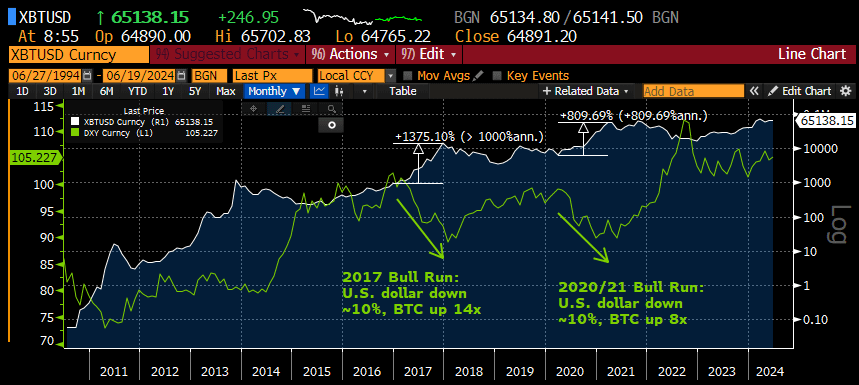
In Chart 1, above, you can clearly see the inverse relationship of the dollar to the price of Bitcoin. (Note: the DXY is about 58 percent Euro, 14 percent Yen, 12 percent Pound, nine percent Canadian Dollar, plus a few other currencies. The Bitcoin price is on a log scale to make the chart meaningful.)
In the 2017 Bitcoin bull market, the dollar (green line) declined by about 10 percent, which helped send Bitcoin (white line) up almost 14x (1,400 percent). Similarly, in the 2020/21 Bitcoin bull market, another 10 percent decline in the dollar sent Bitcoin up over 8x.
Why do such small changes in the dollar have such an outsized impact on the price of Bitcoin?
Many reasons. As the world’s reserve currency, everyone and everything is exposed to the dollar. Over 80 percent of all global trade is conducted in U.S. dollars, even if the goods and countries trading never get near the U.S.
Thus, when the value of the dollar rises against other currencies it is tightening monetary conditions. For example: if you produce maple syrup in Canada and sell a lot of your product into the U.S., you’re good. A stronger U.S. dollar means more sales because your product becomes cheaper to consumers with U.S. dollars. But if your product was really energy-intensive, you’re in trouble, because energy is denominated in U.S. dollars and now your costs are rising. This problem is many times worse if you fund your business with dollar-denominated debt. Now, suddenly your debts and debt service costs are growing and you haven’t borrowed any more money.
A lot of businesses (and countries) are heavy energy importers and have a lot of dollar-denominated debts. A stronger dollar thus means your overhead and your debt service costs rise at the same time. This is what happened in the Asian Financial Crisis in 1997, the DXY went from about 82 to about 102 in two years.
The DXY is also a gauge of global liquidity. If the dollar is high, it means there are less dollars floating around and thus less liquidity. If the Fed is pumping money, the dollar falls because supply has increased. (Technical note: the Fed doesn’t really “create” money per se, it just puts money into the money center bank’s accounts at the Fed. Those banks then lend that money out to your local bakery hedge fund.)
Yeah, Yeah, So When Will the Dollar Fall?
Like everything in finance, success sows the seeds for its own failure. The stronger the dollar gets the more fragile the global economy becomes and eventually something breaks and then the Fed have to lower rates and pump money to address the issue, causing the dollar to fall.
Chart 2: DXY Price, UK Gilt Crisis, and SVB Bank Run
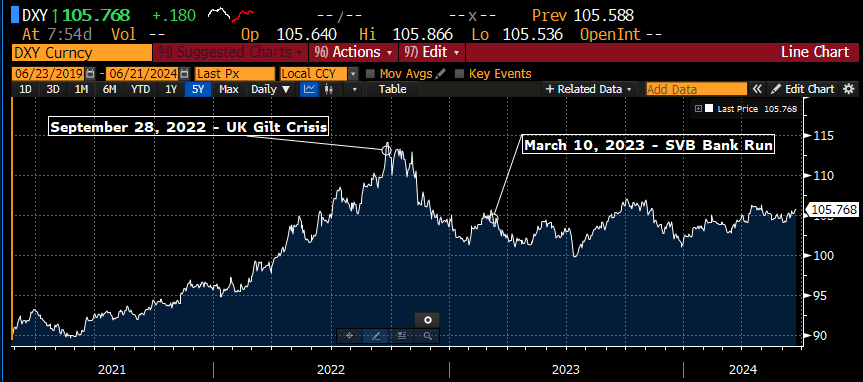
Chart 2, above, shows how the DXY went from 90 to 115 and helped kick off the UK Gilt Crisis, where the BOE had to open the coffers and buy every last gilt that UK pensions had to sell to meet margin calls. This turned the liquidity tide and then the SVB bank run (and subsequent BTFP liquidity pump by the Fed) helped keep the lid on the dollar.
But the dollar has not fallen and the lid is now on Bitcoin.
Can’t we just get another banking crisis?
Absolutely.
The disaster that is Commercial Real Estate (“CRE”), is like a cesspool sloshing around within the regional banks balance sheets. These guys are in trouble and everyone knows it.
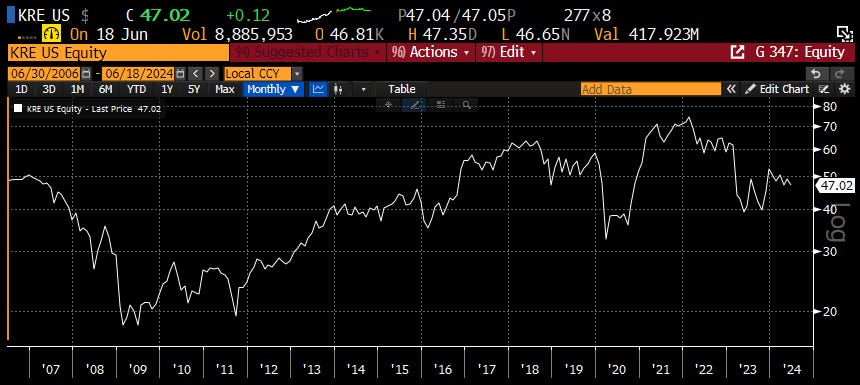
Chart 3: Regional Bank Index
As I’ve written about, CRE is collapsing everywhere you look and you can now pick up empty office buildings for 70 to 95 percent off. (I would invest in these in a heartbeat if I could come up with a catalyst for the turnaround. Hit me up if you have any insights.)
Chart 3, above, shows the Regional Bank Index of stock prices (“KRE”). This chart is as weak as circus lemonade, and it looks like it’s going to $30.
The regional banks are still loaded with long-term treasury bonds that are way under water and their CRE loans have been drowned in the bathtub but they haven’t taken their marks on them yet.
This is a version of the old Soviet method: you pretend to pay us and we’ll pretend you’re solvent. Like the Soviet Union, such a system can’t go on forever, and once the marks start being taken, it will be a flood.
We could also get blowups from a number of other places, including:
China real estate/wider economy causing an RMB devaluation and massive export of deflation;
Right-wingery in Europe causing bond market chaos (rates up), crushing the EU economy, and then rates down big; and,
A Trump win in the U.S. with tax cuts for everyone, increased fiscal spending, and massive money printing. (We’d get higher rates too, which would offset some of the increased dollar supply.)
In the mean time, Bitcoin is likely to be range bound between $58,000 and $72,000.