

If I start off with Yeats, you know it’s going to be heavy.1
We have two events reverberating on the global political stage. On the left there is the Sheinbaum/Morena Party sweep in Mexico, and on the right there are a whole host of parties advancing in France and Germany. (Italy was already there and merely solidified the right’s position.)
Before I analyze this, a digression: I once heard a venture capitalist speak about the cycles in startups. He said there were two types: bundling and unbundling. Budling is what happened to financial firms in the 90’s, they all wanted to become supermarkets where you could one-stop shop for whatever you wanted. Unbundling is what has happened to cable TV over the past decade. People have cut the cord to the solo provider of 600 channels and now everyone subscribes to 3-6 over-the-top platforms to put it all back together again.
I believe we are in the unbundling part of the global geopolitical cycle.
Instead of subscribing to the one world order of globalized capitalism, free markets, and free movement of people, we will have local/regional capitalism, mercantilist policies, tariffs, trade barriers, and immigration bans.
Multi-lateral trade agreements will be torn up and replaced by bi-lateral ones that bestow special privileges upon some and protect favored industries.
Distrust/skepticism will be the default posture between countries because no one is willing to be a team player anymore.
Why Can the Center Not Hold?
The most simple explanation is global wealth inequality, which has gone to recent extremes. (Note that extreme wealth inequality has historically been the norm, and only in the post-war period did we have a reversal of this. See Picketty, Thomas)
Chart 1: Global Wealth Inequality
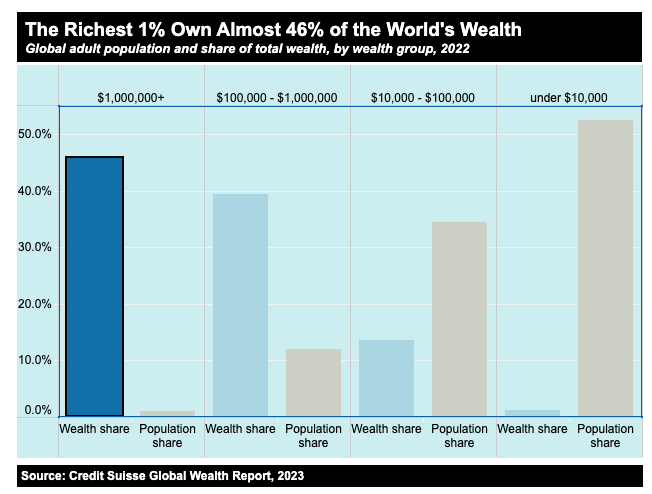
Chart 2: Wealth Share of Ultra-High Net Worth
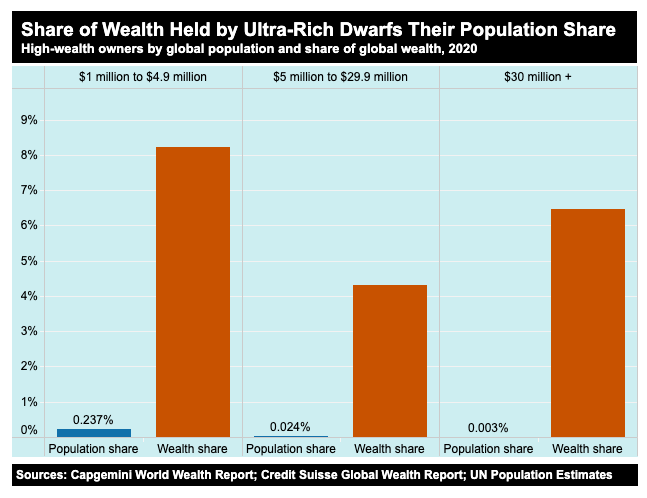
Charts 1 and 2, above, really don’t need much explanation. However, please note that the data are brought to you by the radical libtards at Credit Suisse and Capgemini.
It turns out that the 99 percent are not too keen on wealth inequality. They see elites getting obscenely wealthy (it’s obscene because it’s in your face 24/7 on social media) and they know the system is broken...2
… and if the system is broken, then why not blow it up? This is actually a fair assessment by the have-nots, and you can’t blame them for their anger.
The problem with this is that the reaction movements (and especially the isolationist ones) have historically led to what I would charitably call “suboptimal outcomes”, including, but not limited to this kind of progression:
Inflation → hyperinflation;
Political enmity → civil war;
Trade embargoes → war.
As Bastiat said, “when goods don’t cross borders, soldiers will”.3 So when I see goods being blocked at borders, I’m looking over the stacked containers for the gathering soldiers.
Of course, war is not a guaranteed outcome from tariffs and protectionist trade policies, there have been plenty of protectionist waves for the past millennia that have not resulted in wars. However, the odds go up. (Embargoes on Japan were the final straw before Pearl Harbor.)
What Do the Markets Say?
As good capitalists, we worship the market and it’s ability to aggregate the intelligence of every punter out there. OK, so it’s “intelligence”. Never the less, aggregate it does.
Fun fact: Mr. Market is with the proles.
Chart 1: Mexico 10-Year Bond Yield
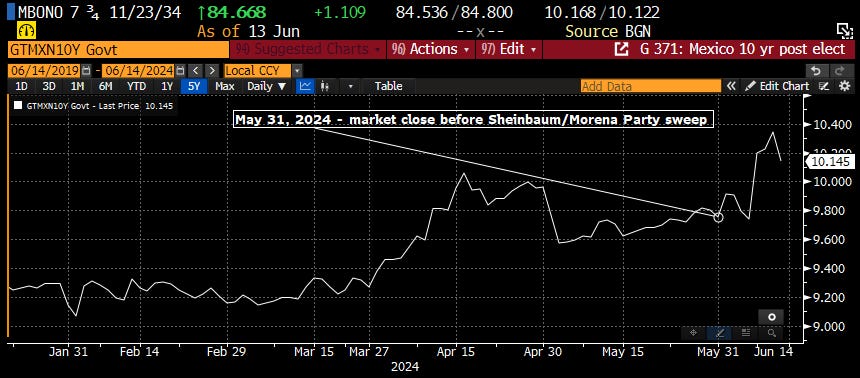
Chart 2: USDMXN
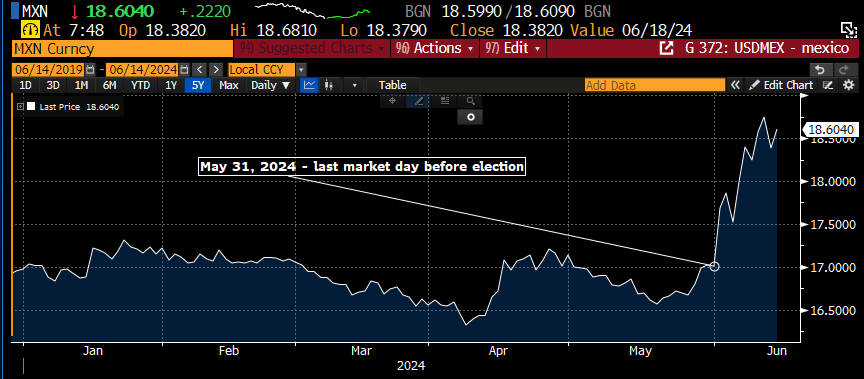
Mexico’s government bonds and currency have been sold hard, post-election. (Chart 2, above, shows how many Mexican Pesos a U.S. dollar will buy, so when it goes up that means it buys more pesos, i.e. peso down.)
The rule of law is something that is gravely under-appreciated in the U.S. We just take it for granted. But when you are investing abroad, the rule of law is a top consideration. With a two-thirds majority in the House, Sheinbaum is in a position to make constitutional changes. That sounds like laws could change to me.
And What about le Francais?
The Euro hasn’t moved much because it’s a lot bigger than just France. The 10-year yield on French government notes spiked a bit, but has settled back. It’s the equities that have reacted.
Chart 3: CAC Quarante
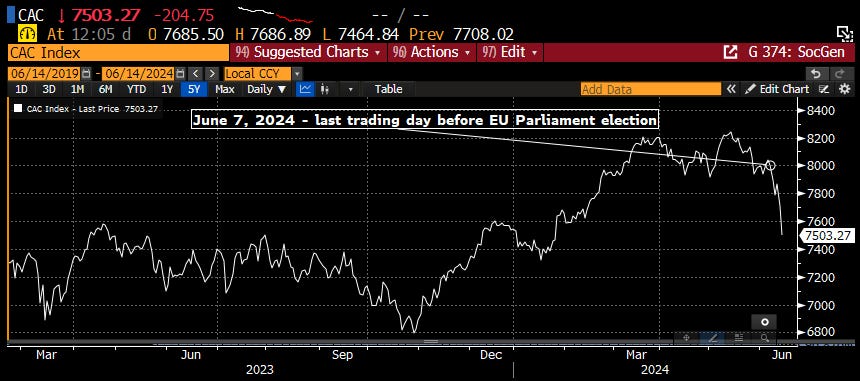
The French stock market has gotten hammered over last week. While constituional changes are not on offer, a Frexit is on everyone’s mind.
And who wouldn’t want to leave the EU? I mean, it went so well for the British. Let’s review:
London’s economy (by itself) has shrunk by over 30B pounds;
The country has lost two million jobs;
Inflation went to crisis levels; and,
The UK economy is almost 140B pounds smaller that it would have been without Brexit.4
Markets are right to worry about countries lurching to political extremes, both left and right, for they give birth to the rough beast that slouches towards Bethehem.
“The Second Coming” by William Butler Yeats. Available at: https://www.poetryfoundation.org/poems/43290/the-second-coming; Accessed June 14, 2024. An amazing poem where about half the lines are quotable.
For the record, I’m all for a system that produces wealthy people and even billionaires, provided that some of that wealth gets recycled back into the system to provide equality of opportunity and services for those who haven’t benefited from the same system that facilitated the wealth creation in the first place.
This is another one of those quotes that is attributed to someone when there is no definitive record of them saying, or writing it. See this from the Foundation for Economic Education: https://fee.org/resources/if-goods-dont-cross-borders/; Accessed June 16, 2024.
New report reveals UK economy is almost 140billion smaller because of Brexit; Mayor of London; January 11, 2024. Available at: https://www.london.gov.uk/new-report-reveals-uk-economy-almost-ps140billion-smaller-because-brexit#:~:text=The%20average%20Briton%20was%20nearly,jobs%20in%20the%20capital%20alone.; Accessed June 16, 2024.